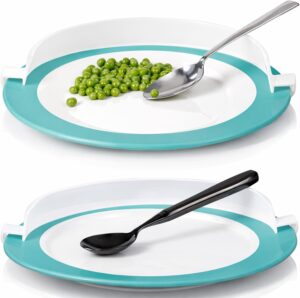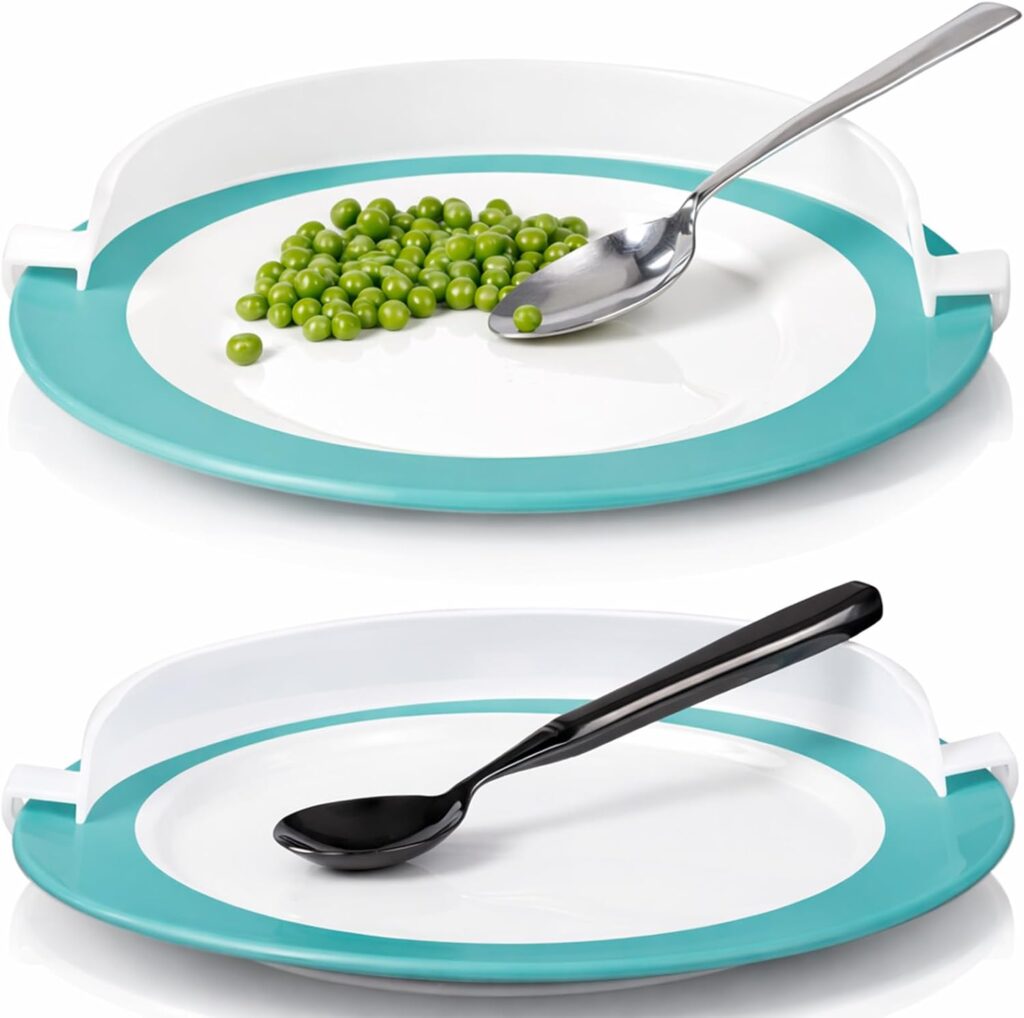
A raised rim gives a single fork or spoon something to push food against.
🔍 WorthSnag’s commitment to transparency: We only recommend products we’ve researched through verified customer reviews, return rate analysis, and brand reputation checks. No paid placements. Our picks are based on real buyer feedback, not commissions.
🍽️ A plate guard is a raised wall or clip-on barrier around the edge of a plate that gives one-handed eaters or people with tremors something to push food against, so a fork or spoon can scoop it up instead of chasing it across an open, flat plate.
🍽️ Part of our Home & Kitchen series. Explore more top-rated mealtime independence finds, including our guides to spill-proof cups for tremors and Parkinson’s and weighted utensils for hand tremors and Parkinson’s.
🍽️ Ready for easier mealtimes? Shop the best plate guards on Amazon →
Scooping food onto a fork usually takes two hands — one holding the fork, the other using a knife or a second utensil to push food up against it so it doesn’t just slide across the plate. Take away the use of one hand, or add a tremor that makes precise pushing motions unreliable, and that simple scooping motion turns into a genuine struggle that can make eating slower, messier, and honestly more stressful than it should be.
A plate guard solves this by giving the food somewhere to go. A raised edge around part or all of the plate means a single fork, pressed against that wall, can scoop food up on its own — no second hand or utensil needed to trap it in place first.
Here’s what I’m covering below:
- Five plate guards worth buying, and where clip-on versus built-in designs actually differ
- Who else benefits from a plate guard beyond one-handed eating specifically
- What to check before buying, so it actually fits the plates you already own
I went through Amazon reviews, caregiver forum threads, and a fair number of complaints about guards that slid around or didn’t fit standard plate sizes, to see which ones actually held up in daily use. Here’s what stood out. 👇
Quick Comparison: Best Plate Guards for One-Handed Eating and Tremors
| Pick | Best For | Design | Price |
|---|---|---|---|
| Vive Plate Guard (2-Pack) | Best Overall | Clip-on, works with your own plates | ~$12–$18 |
| Sammons Preston Clip-On Food Guard | Best Clinically Trusted | Clip-on, reusable | ~$15–$20 |
| Landical Clip-On Plate Guard (3-Pack) | Best Value Multi-Pack | Clip-on | ~$10–$15 |
| Vive Spill-Proof Scoop Plate | Best Built-In Option | Built-in raised wall | ~$15–$20 |
| Modaliv Silicone Scooper Plate with Suction Base | Best for Stability | Built-in wall, suction base | ~$15–$20 |
Clip-On vs. Built-In: The Real Difference
Plate guards split into two genuinely different approaches, and it’s worth understanding which one actually fits your situation:
- Clip-on guards attach to the rim of a plate you already own, using a spring clip or friction grip. You keep using your normal dishes, and the guard comes off when it’s not needed — good for anyone who eats with others and doesn’t want a permanently “adaptive” plate on the table.
- Built-in scoop plates have the raised wall molded directly into the plate itself, usually paired with a non-slip or suction base underneath. There’s nothing to clip on or potentially come loose mid-meal, which matters more for severe tremors where reliability trumps discretion.
Neither is universally better — it genuinely depends on whether you’d rather keep your existing dishes or want the extra reliability of a one-piece design.
The 5 Best Plate Guards for One-Handed Eating and Tremors
1. Vive Plate Guard (2-Pack) — Best Overall
Price: Around $12–$18 | Design: Clip-on, fits standard plates | Included: 2 guards
This is the one that comes up most consistently in reviews from people who’ve actually compared a few different clip-on options. It fits a wide range of standard plate sizes without needing to buy special dishware, and the 2-pack means you can outfit a second plate for a spouse or keep one at a second location.
Why it’s a top pick: Works with the plates already in your cabinet, which matters more than it sounds like for anyone who doesn’t want visibly medical dishware at the table.
Best for: Anyone who wants to keep using their existing plates rather than switching to special adaptive dishware.
Check price on Amazon →
2. Sammons Preston Clip-On Food Guard — Best Clinically Trusted
Price: Around $15–$20 | Design: Clip-on, reusable | Included: 1 guard
Sammons Preston has built a long-standing reputation specifically in occupational therapy and rehab equipment, not general kitchenware, and this guard reflects that — sturdy clip mechanism, straightforward design, no unnecessary extras. If an OT or doctor specifically recommended this brand, this is likely what they meant.
Why it’s a top pick: A trusted, purpose-built design from a brand focused specifically on rehab and adaptive equipment.
Best for: Anyone following a specific clinical recommendation for this exact brand.
Check price on Amazon →
3. Landical Clip-On Plate Guard (3-Pack) — Best Value Multi-Pack
Price: Around $10–$15 | Design: Clip-on | Included: 3 guards
Three guards at a price close to what some brands charge for one means you can outfit breakfast, lunch, and dinner plates without moving a single guard between meals, or send one along when eating at a family member’s house.
Why it’s a top pick: More guards included than any other pick on this list, at a genuinely low per-unit cost.
Best for: Households that want multiple plates permanently outfitted rather than moving one guard around.
Check price on Amazon →
4. Vive Spill-Proof Scoop Plate — Best Built-In Option
Price: Around $15–$20 | Design: Built-in raised wall, non-skid base | Included: 1–2 plates depending on listing
Nothing to clip on and nothing that can slide loose mid-meal — the raised wall is simply part of the plate. For anyone whose tremor is severe enough that a clip-on guard’s grip feels unreliable, this removes that variable entirely.
Why it’s a top pick: One-piece reliability, with no separate part that could shift or detach during a meal.
Best for: More severe tremors where a clip-on attachment doesn’t feel dependable enough.
Check price on Amazon →
5. Modaliv Silicone Scooper Plate with Suction Base — Best for Stability
Price: Around $15–$20 | Design: Built-in wall, suction base | Material: Silicone
The suction base is the standout feature here — it genuinely locks the plate in place on a smooth table, which matters if the plate itself sliding around is as much of a problem as the food sliding on the plate. Silicone construction also means it’s noticeably quieter against a fork than a hard plastic plate.
Why it’s a top pick: Solves plate movement, not just food movement, which none of the clip-on options address.
Best for: Anyone whose tremor or grip issues also cause the whole plate to shift during eating.
Check price on Amazon →
Who Else Benefits From a Plate Guard
One-handed eating and tremors bring most people here, but the same design helps a few other situations:
- Arthritis: reduced grip strength makes coordinating a fork and a second pushing utensil at once genuinely difficult, independent of tremor.
- Vision impairment: a raised edge gives tactile feedback about where the plate’s boundary is, which helps someone locate food by feel rather than relying entirely on sight.
- Cognitive conditions like dementia: a visible, raised boundary can help someone stay oriented to the plate and reduce food being accidentally pushed off the edge.
- Children learning to self-feed: the same scooping mechanics that help adults with tremors also help young kids still developing fork control, though that’s a side benefit rather than the main use case here.
How to Choose the Right Plate Guard
- Clip-on or built-in — decide based on what actually matters more to you. If keeping your regular dishes and discretion at the table matters, go clip-on. If reliability against a severe tremor matters more, go built-in.
- Check plate compatibility before buying a clip-on guard. Most list a compatible plate diameter range — verify your actual plates fall within it rather than assuming a universal fit.
- Consider whether the whole plate needs to stay put, not just the food. If the plate itself slides on the table, a suction-base built-in option solves a problem clip-on guards don’t address at all.
- Buy enough for how many people or meals need one. A multi-pack like the Landical set is more cost-effective than buying single guards repeatedly if more than one plate needs outfitting.
Frequently Asked Questions
How does a plate guard actually help with one-handed eating?
A plate guard adds a raised wall or barrier around part of a plate, giving a single fork or spoon something to push food against so it can be scooped up without needing a second hand or utensil to hold the food in place first.
What’s the difference between a clip-on plate guard and a scoop plate?
A clip-on plate guard attaches to a plate you already own using a spring clip, and can be removed when not needed. A scoop plate has the raised wall built directly into the plate itself, offering more reliability since there’s no separate piece that could shift or come loose during a meal.
Do plate guards work with any size plate?
Most clip-on guards are designed for a specific range of plate diameters, typically standard 9 to 12 inch dinner plates, so checking a product’s stated compatibility before buying helps avoid a poor fit on unusually large or small plates.
Can a plate guard help with hand tremors specifically, not just one-handed eating?
Yes. The raised barrier gives a tremor-affected hand a stable surface to push against, which requires less precise fine motor control than trying to coordinate two utensils at once to trap food in place.
Are plate guards dishwasher safe?
Most silicone and BPA-free plastic plate guards, including clip-on and built-in scoop plate designs, are dishwasher safe, though it’s worth checking a specific product’s care instructions since materials and clip mechanisms can vary.
Final Thoughts
Eating independently shouldn’t come down to fighting your own plate. Any of these five plate guards for one-handed eating and tremors solve the same core problem — giving food somewhere to be pushed against — and the right pick comes down to whether you’d rather keep your existing plates or want the added reliability of a built-in design.
If you’re not sure which approach fits better, the Vive clip-on set is the easiest way to test the concept without committing to new dishware. If tremor severity is the bigger concern, go straight to a built-in scoop plate instead.
For more on daily living support and mealtime independence for people with Parkinson’s, the Parkinson’s Foundation is a genuinely useful, non-commercial resource.
🍽️ Ready for easier mealtimes? Shop the best plate guards on Amazon →